The first possible reason is one that pertains to either that of a small diasporac or a religious history. A diasopora history is a history of a massive migration of a unified group usually caused by some sort of outside factor, and a religious history is one about how a group of people's faith and beliefs have changed over time (Martin and Nakayama, 2010). The town of Stromsburg, Nebraska is one of the Swedish Capitals of the state, with Gothenburg being the other. Sweden is a very rich religious country historically, with 85% of the people belonging to the church of Sweden today, and others belonging to different religions such as Muslim and Buddhism (Palmer, 2011). Perhaps this overwhelmingly large portion of religious people in Sweden and its' history could be the cause for the importance of religion in the town of Stromsburg, NE, as many Swedes immigrated to this town when it was founded.

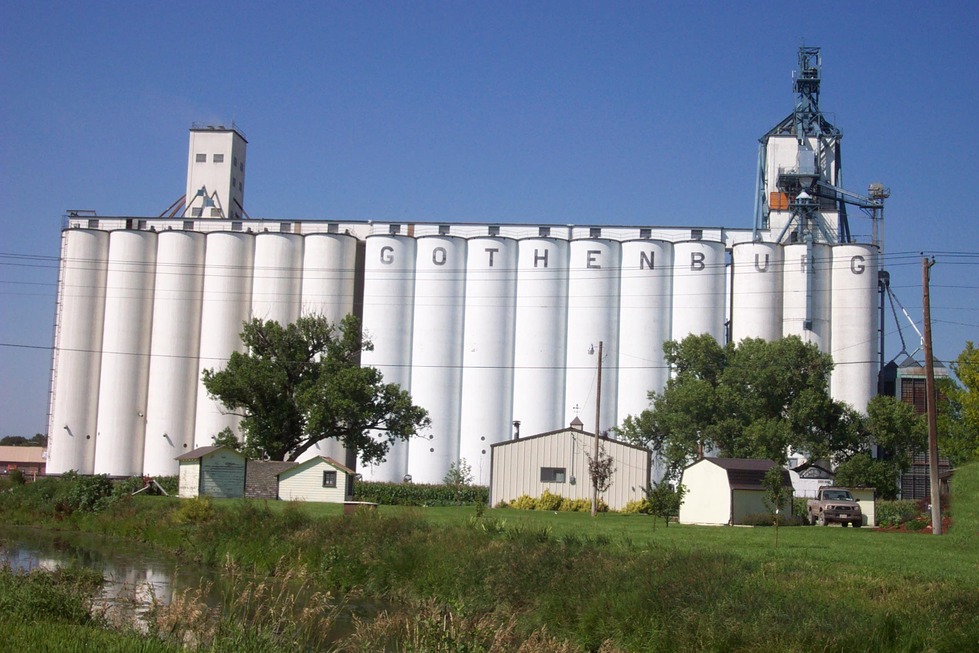
In order to see if this is even more accurate as a possible explanation for the value of religion and faith in Stromsburg, I searched to see if there is a strong presence of churches in Gothenburg, the other Swedish Capital of Nebraska. According to the yellow pages of Gothenburg, there are sixteen churches in the town that has a population of about 3,500 people. To me, this seems proportional to the amount of churches that are in Stromsburg and could be a very logical and plausible explanation for why these two towns of Swedish heritage have such a strong religous background.
A second possibility for a contributing factor in this smalltown church culture is that of cultural space, which is essentially the particular configuration of the communication that constructs meanings of various places (Martin and Nakayama, 2010). Stromsburg's six churches have each been around for a considerable number of years, my home church, the Evangelical Free Church, has been around for a century as of 2010. This fact could imply that there is such a strong sense of faith and religion in Stromsburg because it is our sense of home, purpose, and importance. For those of us who have grown up in this town, it makes sense that being a part of a church and having a strong faith is a large part of who we are and where we have come from.
As we talked about in class regarding the Pequot indians and their casino, perhaps the symbolism of church is to our community what the symbolism of the warrior indian was to their native identity and cultural space.
Over Fall Break I interviewed a friends of mine, Jared Peterson and Ryan Beebe, in order to hear some firsthand thoughts on why Stromsburg has so many churches and such a strong religous culture. Jared is a member of the Stromsburg Baptist Church and has attended church there consistently as he grew up. I merely asked Jared why he thought we had so many churches in our town and what he think contributed to why Stromsburg has such a strong religous culture.
"Our town is a protestant town... and, with that, you get many different kinds of churches (Baptist, E Free, Lutheran, etc.) and different denominations that go with what people think. I think that could have something to do with why there are so many churches" (Field notes, October 17, 2011). This is something that I had not really thought about, and seems to make a lot of sense. Protestants have so many different denominations that new and different churches spring up much more often than towns with other religions.
"In towns where there is a Catholic church you probably won't see many other churches because those towns are kind of dominated by that one church" (Field notes, October 17, 2011). Again, this is something I have seen, as the town next to Stromsburg, Osceola, has a Catholic church and only one other church in the whole town of about 800 people.
"Finally, I think that because a town, my town, has so many elderly people in it, I think this could contribute to the amount of and importance of churches in a community" (Field Notes, October 17, 2011). This answer is one that I felt ties in well with both possibilities mentioned earlier of Religous History and Cultural Space being partially responsible for our strong small town church culture.
In my last blog I will get several more interviews from more elderly people and perhaps a pastor or two from the community in order to further research these possibilities.
Works Cited:
Palmer, Brian C.W. (2011). Culture of Sweden. Retrieved from http://www.everyculture.com/Sa-Th/Sweden.html
Martin, Judith N. & Nakayama, Thomas K. (2010). Intercultural Communication in Contexts. New York, NY, McGraw-Hill
Interviews of Jared Peterson and Ryan Beebe, done on October 17, 2011.
"

I like that you used religious and diasporic histories to open up the blog. I would like to see you focus on cultural spaces for the video and blog #3. Interview and observational data would be very useful here. Think about how you can use these interviews to describe the cultural space. It would be great if you could take some video/pictures of your hometown and all the churches. See the section on postmodern space. I think it could be interesting to apply this to your third blog.
ReplyDelete