Monday, December 5, 2011

A Closer Look at the Differences Between Protestant Denominations in Stromsburg, Nebraska

In my first blog I mainly focused on introducing the small town church culture of Stromsburg, with it's different denominations of churches, swedish background, and also brought up how country music paints the small town culture and the importance of churches inside of it. In my second blog I looked more in depth at the possibilities for why there is such a strong church culture in my small town. The three main options I focused on were the diaspora and religious history, the possibility of a cultural space, and finally the possibility that the different denominations could have different views, which could result in the large attendance at each of the six churches.

For this final blog, I decided to focus more on the differences between the denominations of protestant churches in my small town of Stromsburg. On top of this, I wanted to end this project by expanding on how we can continue to look into this phenomenon in the future.
To begin, I found this video on youtube that goes into the different denominations of protestant churches:
http://www.youtube.com/watch?v=Mc607nceUO8

This video goes into a little depth about the denominations of Lutherans, Methodists, Baptists, and Presbyterians, which covers three of the six different denominations that are present in Stromsburg. The other three denominations are the Covenant church, the Evangelical Free church, and the Living Word church.

After doing some research, I found that most protestant churches are basically the same in their origin, as they are all reformations of the original Catholic church. Many of the differences between these churches tend to be small, and are mostly found in the church's Statement of Faith. For example, in a small interview I did with my father, who is an elder in our church, he said that the main difference between a the Evangelical Free church denomination and the Baptist denomination comes on the issue of baptism (field notes, December 4, 2011). Also, a difference between the Evangelical Free church and the Covenant church is that the first has a Statement of Faith consisting of ten different points, whereas the Covenant church has a list of five affirmations and then six resolutions (efca.org and covchurch.org).

With regard to the Living Word church, they are actually a non-denominational church.

Now, to wrap up this project as a whole, I focused my video on the three main answers I had to my original question of "why is there such a strong small-town church culture in my hometown of Stromsburg, Nebraska?". These three points were, as I mentioned earlier, the possibilities of a diaspora and religious history, the different denominations of protestant churches, and also the possibility of church culture as a cultural space. After doing all my research and interviews, I personally think that the largest cause for this in my hometown is the fact that church is a sort of cultural space in my community. I mean this in that people in my community have been going to church for as long as they can remember, and for many people it has simply become a given in their way of life, or a integral part of their routine life.

To close this project, I want to give some insight on where this could go in the future. Personally, I believe my most valuable sources of information throughout this research were interviews of people in the community, and I would point in this direction as the way to go in the future. This is the most accurate way to gauge why people go to church and what reasons have an affect on that. Also, it gives good insight into why there is such a strong church culture in my small town.

Bibliography:

Interview with Kurt Moore done on December 4, 2011

Evangelical Free Church of America (2008). Statement of Faith. Retrieved from http://www.efca.org/about-efca/statement-faith on December 5, 2011.

The Evangelical Covenant Church (2011). Who We Are: Affirmations and Resolutions. Retrieved from http://www.covchurch.org/who-we-are/beliefs/ on December 5, 2011.

Sunday, October 30, 2011

Part 2: Oh, the Possibilities!

For this second cultural reporter blog, I will dive into several possible explanations as to why my hometown of Stromsburg, NE has so many churches and why religion is such a big part of our smalltown culture, even though it is a town of 1,200 residents.

The first possible reason is one that pertains to either that of a small diasporac or a religious history. A diasopora history is a history of a massive migration of a unified group usually caused by some sort of outside factor, and a religious history is one about how a group of people's faith and beliefs have changed over time (Martin and Nakayama, 2010). The town of Stromsburg, Nebraska is one of the Swedish Capitals of the state, with Gothenburg being the other. Sweden is a very rich religious country historically, with 85% of the people belonging to the church of Sweden today, and others belonging to different religions such as Muslim and Buddhism (Palmer, 2011). Perhaps this overwhelmingly large portion of religious people in Sweden and its' history could be the cause for the importance of religion in the town of Stromsburg, NE, as many Swedes immigrated to this town when it was founded.
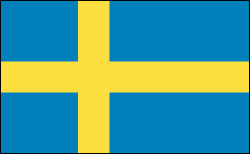
Flag of Sweden
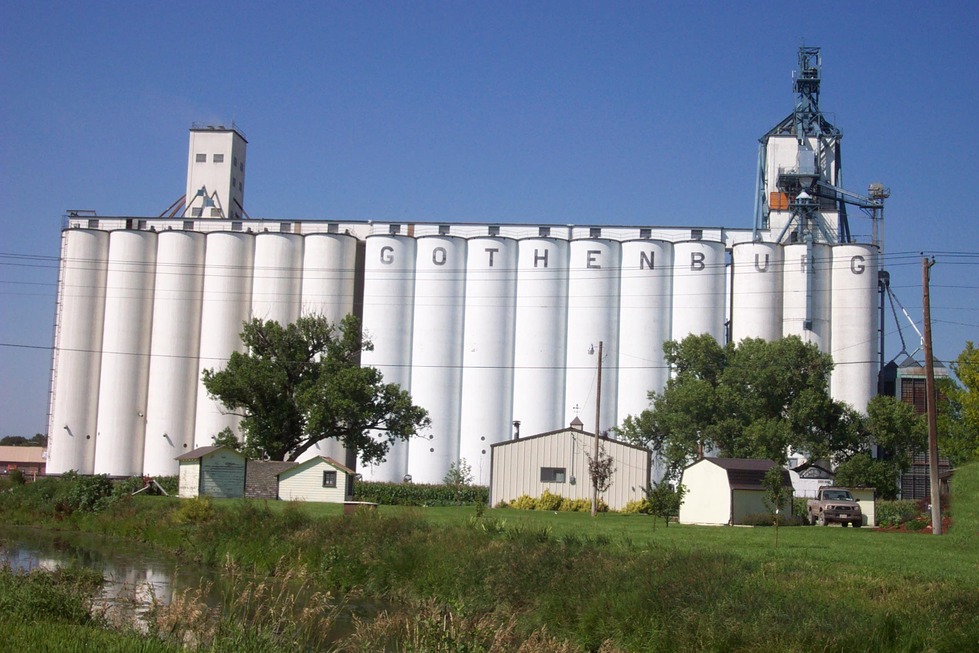
In order to see if this is even more accurate as a possible explanation for the value of religion and faith in Stromsburg, I searched to see if there is a strong presence of churches in Gothenburg, the other Swedish Capital of Nebraska. According to the yellow pages of Gothenburg, there are sixteen churches in the town that has a population of about 3,500 people. To me, this seems proportional to the amount of churches that are in Stromsburg and could be a very logical and plausible explanation for why these two towns of Swedish heritage have such a strong religous background.
Gothenburg, NE : Gothenburg Cyloes
A second possibility for a contributing factor in this smalltown church culture is that of cultural space, which is essentially the particular configuration of the communication that constructs meanings of various places (Martin and Nakayama, 2010). Stromsburg's six churches have each been around for a considerable number of years, my home church, the Evangelical Free Church, has been around for a century as of 2010. This fact could imply that there is such a strong sense of faith and religion in Stromsburg because it is our sense of home, purpose, and importance. For those of us who have grown up in this town, it makes sense that being a part of a church and having a strong faith is a large part of who we are and where we have come from.
As we talked about in class regarding the Pequot indians and their casino, perhaps the symbolism of church is to our community what the symbolism of the warrior indian was to their native identity and cultural space.

Over Fall Break I interviewed a friends of mine, Jared Peterson and Ryan Beebe, in order to hear some firsthand thoughts on why Stromsburg has so many churches and such a strong religous culture. Jared is a member of the Stromsburg Baptist Church and has attended church there consistently as he grew up. I merely asked Jared why he thought we had so many churches in our town and what he think contributed to why Stromsburg has such a strong religous culture.

"Our town is a protestant town...  and, with that, you get many different kinds of churches (Baptist, E Free, Lutheran, etc.) and different denominations that go with what people think. I think that could have something to do with why there are so many churches" (Field notes, October 17, 2011). This is something that I had not really thought about, and seems to make a lot of sense. Protestants have so many different denominations that new and different churches spring up much more often than towns with other religions.

"In towns where there is a Catholic church you probably won't see many other churches because those towns are kind of dominated by that one church" (Field notes, October 17, 2011). Again, this is something I have seen, as the town next to Stromsburg, Osceola, has a Catholic church and only one other church in the whole town of about 800 people.

"Finally, I think that because a town, my town, has so many elderly people in it, I think this could contribute to the amount of and importance of churches in a community" (Field Notes, October 17, 2011). This answer is one that I felt ties in well with both possibilities mentioned earlier of Religous History and Cultural Space being partially responsible for our strong small town church culture.

In my last blog I will get several more interviews from more elderly people and perhaps a pastor or two from the community in order to further research these possibilities.

Works Cited:

Palmer, Brian C.W. (2011). Culture of Sweden. Retrieved from http://www.everyculture.com/Sa-Th/Sweden.html

Martin, Judith N. & Nakayama, Thomas K. (2010). Intercultural Communication in Contexts. New York, NY, McGraw-Hill

Interviews of Jared Peterson and Ryan Beebe, done on October 17, 2011.


"

Sunday, September 25, 2011

Intro to Small-Town Church Culture

Growing up in the town of Stromsburg, NE, I was surrounded with all of your typical ideals and traditions that a small town in Nebraska would hold; hard work, friendliness, discipline, family, and faith. Faith is something that has become of the utmost importance in my life, and largely due to the environment I was brought up in. Stromsburg has six different churches, ranging in denomination from the Covenant, Methodist, Baptist, Lutheran, and Evangelical Free churches. I grew up going to the Evangelical Free church in Stromsburg, but as I thought about this project, I began to think about the culture of a small town and, as I mentioned above, the ideal and tradition of faith in the community.


I guess growing up I had never really thought too much about why people in small towns go to church, or, why it seems like EVERYONE in a small town goes to church on Sunday. So this project somehow sprung this idea up in my head and I am very excited to investigate this unique culture that I was brought up in, but never really noticed much in the past twenty years of my life. This seems strange to me, as a community with only 1,241 residents would have six churches that are full of people every sunday of the year, and I would never even think about its importance in the role that it plays in the culture of a small town in Central Nebraska.

Perhaps this idea of how religion plays into the culture of small-town, USA communities can be seen in many different ways, including songs:
http://www.youtube.com/watch?v=D0sYnro_3Rc&ob=av2e

I'm sure there are many other songs that potray the importance of church in these small town communities, and I think this is something that will be very important to consider in throughout my investigation of this culture, as to why small town communities identify so heavily with church as part of their culture. Is it a true ideal that they hold and believe in themselves? Or is it something they do because the vast majority of our country puts small towns in this broad stereotype of friendly people who go to church on Sunday? Why is church such a large part of small towns in the US and Nebraska? And, specifically, Stromsburg, NE?

In order to obtain insight for these questions I will interview various friends from my community to get their ideas on why church is so important in small towns, and why they think nearly everyone in a small town attends a church, even if it may not be the most important aspect of their lives. To say the least, I am very curious about this unique aspect of a small town culture, and I am very excited to see the answers that are revealed throughout the remainder of this project.

Works Cited:
http://www.stromsburgnebraska.com/about.asp